Flat iron steak: where it comes from and its names in six systems
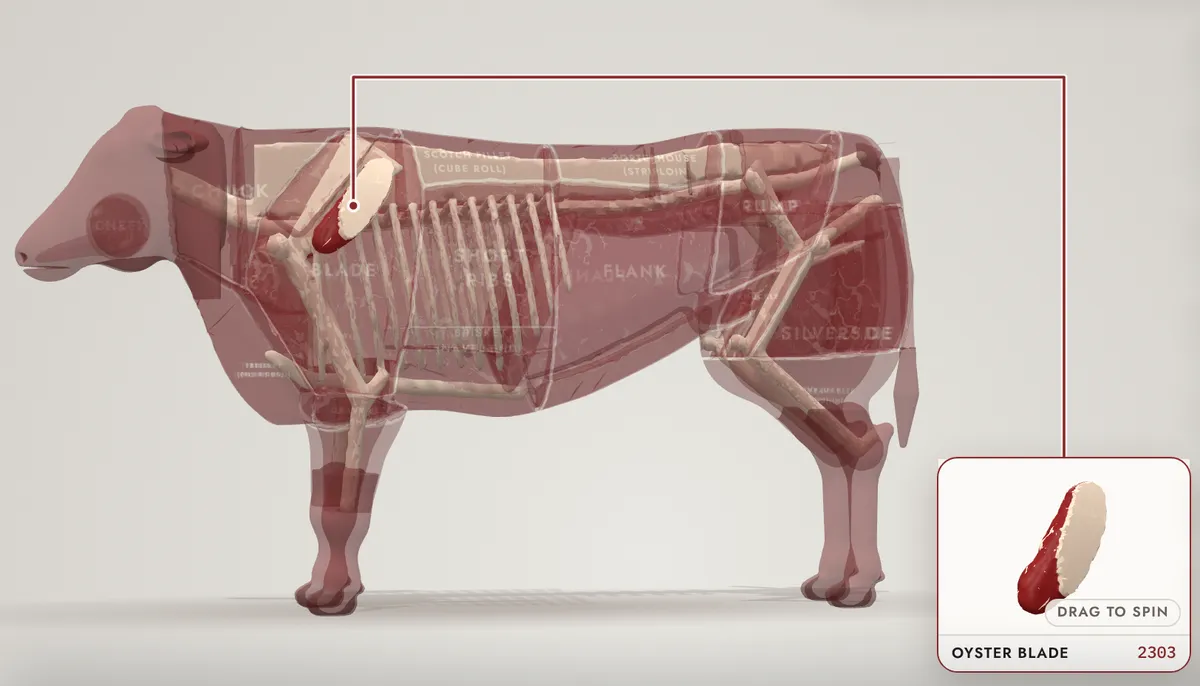
The oyster blade (US top blade) with its central gristle cut out, which leaves two flat, tender steaks. The same muscle is ミスジ in Japan and 부채살 in Korea.
All six systemsM. infraspinatus · trade names and codes
- USUnited States
- Top blade; flat iron steak (NAMP 114D)
- UKUnited Kingdom
- Feather (feather blade); flat iron steak
- AUAustralia
- Oyster blade steak; Flat iron steak (when fully trimmed)
Trade: Oyster blade (HAM 2303; alt. Top blade) - 日Japan (yakiniku)
- ミスジ misuji
- 한Korea (BBQ)
- 부채살 buchaesal
- 中Hong Kong (Cantonese)
- 牛板腱
Same muscle as UK feather / US flat iron. HAM 2303 also carries a thin layer of M. trapezius. The central gristle line is removed to make flat iron.
FQ-01Each system cuts the carcase into different primals. Tap one to see that system's chart on the 3D steer. (part) = a straight line splits this piece between two primals.
How to ask a butcherWhat to say in each country
In Australia, 'oyster blade steak' is usually cut across the muscle and keeps a strip of gristle. Ask for flat iron, or for the oyster blade whole and split it yourself.
Show the butcher the name for their country. Codes: HAM = AUS-MEAT item number, NAMP = US Meat Buyer's Guide number.
Cut it and cook it at homeGrill ✓ · Hot pot ✓ · KBBQ ✓ · Soup ✗
- Lay the whole oyster blade flat. Run the knife along the top of the gristle to lift off the first steak.
- Turn the rest over and cut the gristle off the second steak.
- Keep the gristle strip for stock or a braise.
With the gristle gone it is tender and beefy. Cook fast and slice across the grain.
Thin and small for roasting; better grilled.
Works, but you have paid for trimming that braising does not need. Braise the whole oyster blade instead.
Shaved thin it is tender and has no gristle to chew.
ミスジ / 부채살 without the gristle.
Too tender and too costly for broth, and with the gristle gone there is little left to give it body; use shin or brisket.
Cooking ratings are the atlas's own, from the fat, grain and connective tissue of the cut.
Name trapsTwo Australian names, two different steaks · Not the 'flat' of a brisket
An oyster blade steak is cut across the muscle and has gristle in the middle; a flat iron is cut along it and has none.
'Flat' in US brisket talk is the deep pectoral muscle of the breast; flat iron is from the shoulder blade.
Sources11 sources for the names
- S1 · AUS-MEAT Ltd, AUS-MEAT, Handbook of Australian Meat database — individual cut code sheets
- S3 · Meat & Livestock Australia (australianbeef.com.au), Beef cuts (consumer guide)
- S5 · AHDB Beef & Lamb (UK), Meat Purchasing Guide, 8th edition (March 2019)
- S9 · Toyonishi Farm (トヨニシファーム), Hokkaido, 牛肉3D部位解説 (Beef 3D part commentary)
- S11 · Hiroshi Takahashi, note.com, 焼肉部位解説② みすじ・とうがらし
- S12 · Gyeongsangnam-do Agricultural Research & Extension Services, 소 도체의 대·소분할 부위별 정형 (official primal and subprimal definitions)
- S20 · Wagyu Wholesale Ltd (Hong Kong), 和牛食用部位
- S21 · DRFS (Hong Kong), 日本和牛的不同部位
- S39 · Certified Angus Beef Hong Kong, 牛肉部位 (beef cuts list)
- S51 · United Nations Economic Commission for Europe, UNECE Standard: Bovine Meat Carcases and Cuts, 2004 edition (ECE/TRADE/326)
- S52 · US Meat Export Federation (USMEF) Japan, アメリカン・ミート ニュー・カットガイド (American Meat New Cut Guide), May 2015
Names come from the atlas's muscle table (record FQ-01, BF-09); an approx. tag marks an approximate match, or one still being checked. The model picture is a screenshot of the atlas's own 3D model, not a photo.