金錢𦟌 approx. gam1 cin4 zin2
Gam cin zin (金錢𦟌): what it is in English
Also written: 金錢展
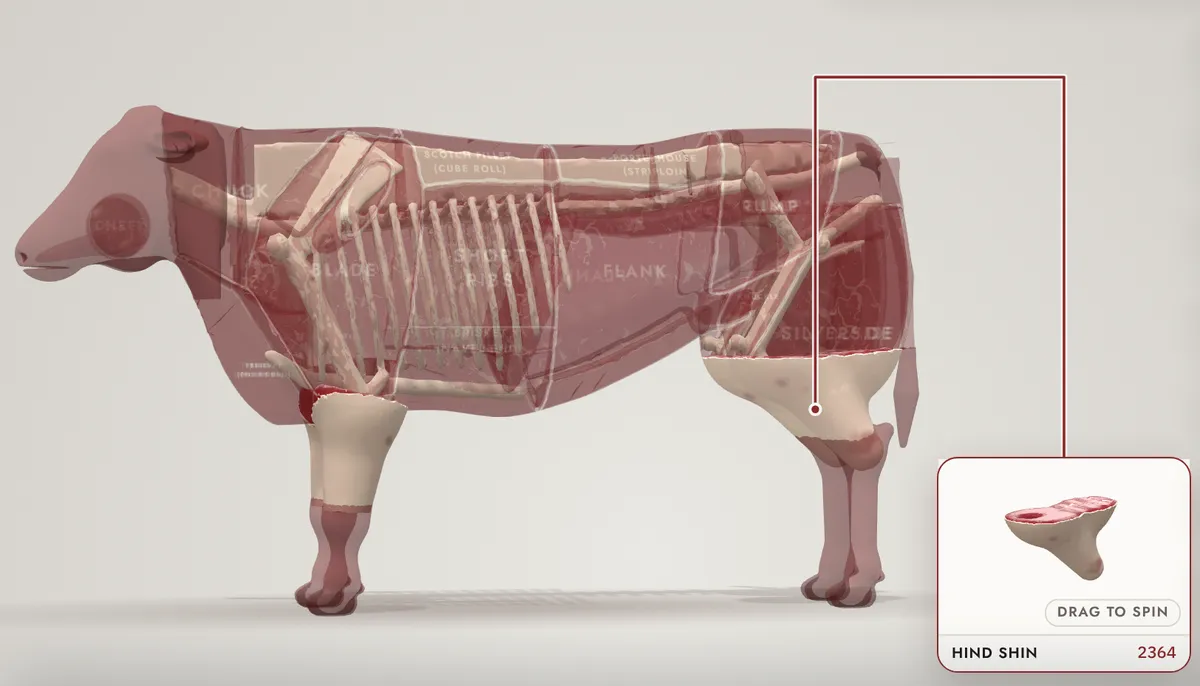
金錢𦟌 is the Hong Kong name for a small muscle wrapped inside the heel at the back of the hind shin, streaked with tendon. It is prized in Hong Kong (金錢𦟌) and Korea (아롱사태). The match is approximate.
safety Korea also eats 아롱사태 raw, as yukhoe. Raw beef can carry E. coli O157; after a 2011 yukhoe outbreak, Japan set strict rules for serving raw beef. This site has no raw-beef recipes.
All six systemsM. flexor digitorum superficialis (hind leg) · trade names and codes
- USUnited States
- part of heel
- UKUnited Kingdom
- Pencil muscle approx.
- AUAustralia
- no separate name
Trade: part of Heel muscle (HAM 2364) - 日Japan (yakiniku)
- センボン senbon approx.
- 한Korea (BBQ)
- 아롱사태 arongsatae
- 中Hong Kong (Cantonese)
- 金錢𦟌 / 金錢展 (金錢腱) approx.
Korean official definition: 얕은뒷발가락굽힘근 joined to the Achilles tendon; prized for yukhoe (raw beef). Hong Kong sources describe 金錢𦟌 as the core (𦟌心) wrapped inside a large shin muscle near the tail, two per animal; the Mainland name is 五花趾. That fits this muscle, as with Korean 아롱사태.
Still being checked: UK: AHDB says the pencil muscle is part of the heel muscle, not confirmed as this muscle. Cantonese: matched by position, not by a source naming the muscle. The character 𦟌 may not display on every device; 展 is the usual substitute. Japanese: USMEF Japan sells the US heel meat as センボン (千本筋) and the digital flexor separately as ダキチマキ dakichimaki, so this muscle may be ダキチマキ and センボン the heel meat as a whole (HQ-16). Unresolved.
HQ-17Each system cuts the carcase into different primals. Tap one to see that system's chart on the 3D steer. (part) = a straight line splits this piece between two primals.
How to ask a butcherWhat to say in each country
Show the butcher the name for their country. Codes: HAM = AUS-MEAT item number, NAMP = US Meat Buyer's Guide number.
Cut it and cook it at homeGrill ✗ · Roast ✗ · Braise ✓ · KBBQ ✗ · Soup ✓
- Braise it whole, cool it, then slice to show the tendon pattern.
safety Korea also eats 아롱사태 raw, as yukhoe. Raw beef can carry E. coli O157; after a 2011 yukhoe outbreak, Japan set strict rules for serving raw beef. This site has no raw-beef recipes.
Cooking methodsToo sinewy to grill.
Too sinewy to roast.
Prized for braising: the tendon streaks turn soft.
Some slice it thin for hot pot as a lean option; not a usual hot-pot cut, though Hong Kong's specialist hand-cut hot-pot restaurants serve it as a rare extra.
Too sinewy.
Excellent in soup.
Cooking ratings are the atlas's own, from the fat, grain and connective tissue of the cut.
Sources9 sources for the names
- S1 · AUS-MEAT Ltd, AUS-MEAT, Handbook of Australian Meat database — individual cut code sheets
- S5 · AHDB Beef & Lamb (UK), Meat Purchasing Guide, 8th edition (March 2019)
- S9 · Toyonishi Farm (トヨニシファーム), Hokkaido, 牛肉3D部位解説 (Beef 3D part commentary)
- S12 · Gyeongsangnam-do Agricultural Research & Extension Services, 소 도체의 대·소분할 부위별 정형 (official primal and subprimal definitions)
- S15 · KoreaScience (industry magazine), 쇠고기의 특수부위 및 부산물
- S26 · KKNews (每日頭條), 常見的進口牛肉詞彙總結與討論
- S40 · Lee Kum Kee Hong Kong (李錦記), 火鍋牛肉部位 (hotpot beef parts)
- S41 · Sing Tao Headline (星島頭條), 火鍋牛肉部位|騸牯牛頭號買手解構7大必食手切肥牛 (16 Oct 2023)
- S52 · US Meat Export Federation (USMEF) Japan, アメリカン・ミート ニュー・カットガイド (American Meat New Cut Guide), May 2015
Names come from the atlas's muscle table (record HQ-17); an approx. tag marks an approximate match, or one still being checked. The model picture is a screenshot of the atlas's own 3D model, not a photo.