牛腩 approx. ngau4 naam5
Ngau naam (牛腩): what it is in English
Beef belly: the navel end of the brisket and the flank, braised for Cantonese 炆牛腩. It is often translated 'brisket', but it is not the brisket point end.
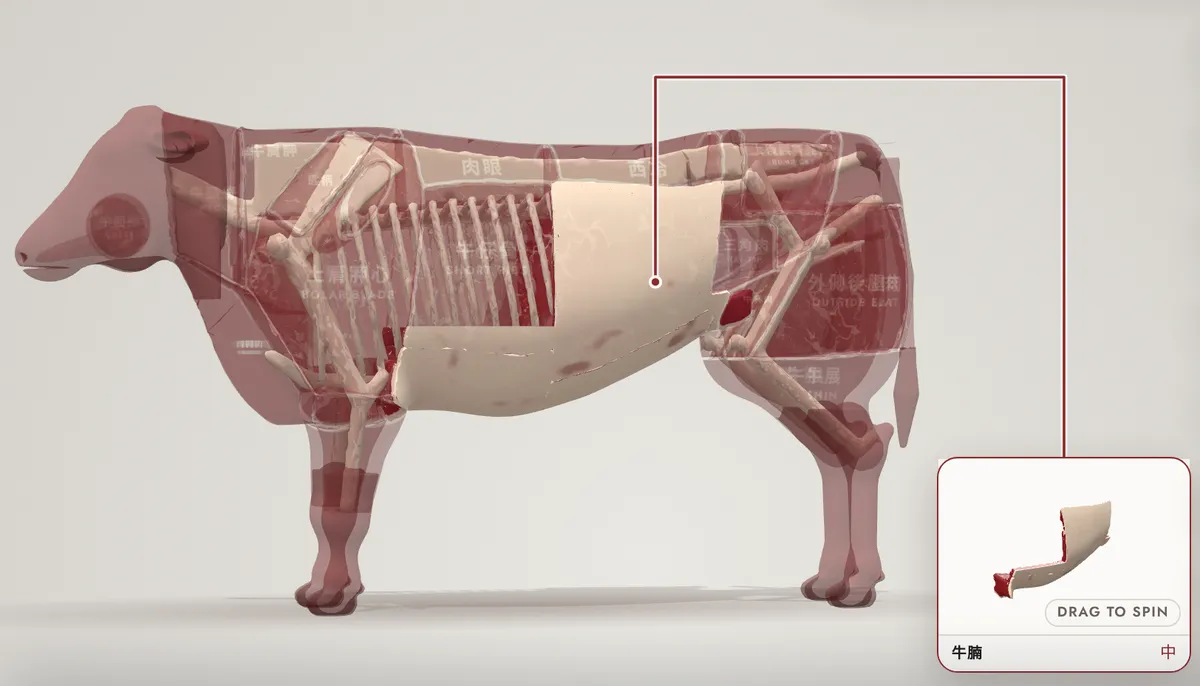
All six systemsShort plate / belly: M. cutaneus trunci, rear of M. pectoralis profundus, intercostals, abdominal muscles · trade names and codes · its parts
- USUnited States
- Short plate (navel)
- UKUnited Kingdom
- Thin flank
- AUAustralia
- Navel end brisket
Trade: Short plate (HAM 2346); Brisket navel end (HAM 2342) - 日Japan (yakiniku)
- ショートプレート shōto purēto
- 한Korea (BBQ)
- 업진살 eopjinsal approx.; 우삼겹 usamgyeop (sliced thin)
- 中Hong Kong (Cantonese)
- 牛腩 (generic belly) approx.; 胸腹肉 (plate, trade)
Korean 우삼겹 is short plate sliced thin (per Korean Wikipedia).
Still being checked: Composite record; mappings approximate.
CC-02Source: S18.
Each system cuts the carcase into different primals. Tap one to see that system's chart on the 3D steer. (part) = a straight line splits this piece between two primals.
How to ask a butcherWhat to say in each country
In Australia ask for brisket navel end, not point end. Boneless rib fingers also work for 炆牛腩.
Show the butcher the name for their country. Codes: HAM = AUS-MEAT item number, NAMP = US Meat Buyer's Guide number.
Cut it and cook it at homeGrill ✗ · Braise ✓ · Hot pot ✓ · KBBQ ✓ · Soup ✓
- Cut into large chunks along the layers; it shrinks a lot as it braises.
- Leave the fat and membranes on: they turn soft and gelatinous.
Tough and layered as a steak.
Possible low and slow; not the usual use.
Its layers of fat and connective tissue turn soft: 炆牛腩, the classic.
Shaved thin it is fatty, tender hot-pot beef; Hong Kong shops hand-slice parts of 牛腩 (腩頭, 腩心) for hot pot.
Sliced paper-thin, the same area is Korean 우삼겹.
Simmered in clear broth for beef brisket noodles.
Cooking ratings are the atlas's own, from the fat, grain and connective tissue of the cut.
Name traps牛腩 isn't brisket
A recipe that says 'beef brisket' for 牛腩 means belly. The Australian point end or US packer brisket is a different part.
Sources16 sources for the names
- S1 · AUS-MEAT Ltd, AUS-MEAT, Handbook of Australian Meat database — individual cut code sheets
- S2 · AUS-MEAT / MLA Japan, Handbook of Australian Meat, 7th ed., Japanese edition — boneless beef, offal and variety items indexes
- S3 · Meat & Livestock Australia (australianbeef.com.au), Beef cuts (consumer guide)
- S4 · Meat & Livestock Australia, MSA beef primal and sub-primal cuts poster (2018)
- S5 · AHDB Beef & Lamb (UK), Meat Purchasing Guide, 8th edition (March 2019)
- S9 · Toyonishi Farm (トヨニシファーム), Hokkaido, 牛肉3D部位解説 (Beef 3D part commentary)
- S12 · Gyeongsangnam-do Agricultural Research & Extension Services, 소 도체의 대·소분할 부위별 정형 (official primal and subprimal definitions)
- S15 · KoreaScience (industry magazine), 쇠고기의 특수부위 및 부산물
- S16 · Daum cafe 한국조리용어, 소고기의 영어 용어 (Korean–English butchery glossary)
- S18 · HK01 (Hong Kong), 牛腩分3種:爽腩/坑腩/崩沙腩
- S19 · JC in UK blog, 英國買牛肉全攻略 (Cantonese–English cut table)
- S37 · Korean Wikipedia, 쇠고기 부위
- S39 · Certified Angus Beef Hong Kong, 牛肉部位 (beef cuts list)
- S40 · Lee Kum Kee Hong Kong (李錦記), 火鍋牛肉部位 (hotpot beef parts)
- S51 · United Nations Economic Commission for Europe, UNECE Standard: Bovine Meat Carcases and Cuts, 2004 edition (ECE/TRADE/326)
- S52 · US Meat Export Federation (USMEF) Japan, アメリカン・ミート ニュー・カットガイド (American Meat New Cut Guide), May 2015
Names come from the atlas's muscle table (record CC-02, ); an approx. tag marks an approximate match, or one still being checked. The model picture is a screenshot of the atlas's own 3D model, not a photo.